Creative Content with Artificial Intelligence: Legal Risks and Consequences
23 November 2026
Over the past few years, artificial intelligence (AI) technologies have become widely used in our lives. More and more often, we turn to AI on any issue of interest to us. We use algorithms in our professional activities. And with each query, we train AI so that its subsequent response is more complete and reliable.
However, in addition to obtaining information or processing analytical data, artificial intelligence is intensively used to create all types of products in the fields of literature, science and art: images, music, texts, videos, etc., which are generated on the basis of the content of a particular model and through dialogue with its user.
In this case, can the generated result be new, or is such a product each time is an adaptation of something that already exists? Often, without considering the degree of originality of the resulting product, the user claims exclusive rights to any work produced by AI, which generally accords with the terms of most user agreements, under which AI developers recognize copyright as belonging to the user. From a legal standpoint, such terms of user agreements operate only in respect of creative content that is eligible for copyright protection and does not infringe third-party rights.
Pursuant to Articles 1228 and 1257 of the Civil Code of the Russian Federation (the Civil Code), copyright protects only a work created by the creative effort of a human being. This presumption derives from the classical doctrine of copyright and has been implemented in the national laws of many countries.
Thus, under the current legal framework, a human creative contribution is a mandatory criterion for copyright to arise in a work created with the assistance of AI. At the same time, pursuant to Article 1259 of the Civil Code, a work is protected irrespective of its merits and purpose. A child’s drawing may also receive copyright protection on an equal footing with a painting by an honored artist. What matters is the creative idea conceived by a person, while the means of expressing it may vary: traditional paints or musical notation, or technical tools involving the use of a computer program and database embedded in AI. In the latter case, the author’s idea is formulated in dialogue with AI.
However, an idea itself is not protected by copyright; what matters is the form in which it is expressed as a specific work. This gives rise to a natural question: how much detailed must the user’s prompt be in order for the user subsequently to claim creative participation in the creation of the generated product and, consequently, its eligibility for protection? Practice in foreign countries provides different answers to this question. Nevertheless, in most cases, the user must demonstrate active steps in interacting with AI in the course of implementing the user’s creative concept and authorial participation in creating the final product.
Turning to foreign practice, it is worth noting the approaches that have been developed in the United States of America (USA). The principal U.S. law governing authorship is the Copyright Act of 1976, which embodies the traditional principle for determining authorship and contains no special provisions on the allocation of rights in works created wholly or in part with the use of AI algorithms. Guided by the existing rules, the U. S. Copyright Office and the courts recognize copyright only in the portion created by the human being.
For example, when considering Kristina Kashtanova’s application to register the comic book “Zarya of the Dawn” (“ZARRYA OF THE DAWN”), the Office recognized Kristina’s authorship only in the text written by her and in the original compilation of the comic book elements, while rejecting claims to copyright protection for digital works of art created by a neural network. (AI) Zarya of the Dawn – Midjourney – Kris Kashtanova
It appears unlikely that clear statutory criteria can be established for assessing the level of creative contribution sufficient for copyright to arise where AI is used, and the standard of proof will be developed through case law.
Thus, in 2025, the Presnensky District Court of Moscow considered Civil Case № 02‑4220/2025 concerning a claim for compensation for the unlawful use of two “art objects” [the claimant’s terminology] created with the use of the Photoshop computer program.
As follows from the court’s decision, the claimant asserted that he held copyright in images of Leonardo da Vinci’s painting “Mona Lisa” and the “Statue of Liberty” sculpture in New York, which he modified using the tools of that program: he changed the position of the Mona Lisa’s arm and placed a glass of wine in her hand, altered her hair to make it disheveled, changed her facial expression and added patches under her eyes; he also replaced the torch in the Statue of Liberty’s hand with a glass of wine.
After discovering that the defendant was selling products using the images he had created, the claimant sought an award of compensation. The court agreed that the creative nature of the creation of a work does not depend on whether the work was created by the author by hand or with the use of technical means. At the same time, however, it did not recognize the claimant as the right holder, having concluded that the creative component contributed by the claimant to the creation of the disputed objects was insufficient.
In explaining its decision, the court stated:
“…creative activity should be understood as any theoretical or practical human activity that results in new results, material products, methods of action, solutions or knowledge. The creative element is concentrated in that part of the activity which, by virtue of a certain degree of regulation, also contains a certain degree of uncertainty, i. e. a ‘zone of creative freedom’. If a computer program plays a significant role in the creation of an object, such an object cannot be regarded as the result of human creative activity…
Copyright protects only the result of human creative activity. For objects to be recognized as objects of copyright, it is necessary to assess whether the work contains a discernible human creative contribution.”
The court viewed critically the claimant’s arguments that he had made a discernible and sufficient creative contribution to the creation of the disputed images, because it considered that the claimant’s ideas underlying the changes were not new and that such images, including images in which a person holds a glass of wine, champagne or beer, had been used by many persons long before the date on which the disputed objects were created.
The claimant disagreed with the decision and appealed it. According to information published on the official website of the Moscow City Court, the decision of the court of first instance was partially set aside and a new decision was rendered on 16 September 2026. However, at present the appellate ruling has not yet been published, and the reasons for the revision of the decision are unknown.
In another case, № A40‑200471/2023, considered by the Commercial Court of the City of Moscow, copyright in a video created using Deep-fake technology was protected, and compensation in the amount of RUB500,000 was awarded for its unauthorized use in advertising. In his defense, the defendant attempted to challenge the eligibility of the disputed video for protection on the ground that Deepfake technology had been used. However, the court found those arguments unfounded, stating that the technology had been used as an additional processing tool (technical editing) for the original video materials, which had been created through the creative work of a group of persons who wrote the script for the video, carried out the video recording and provided the audio accompaniment.
The court decisions referred to above confirm the application of the traditional doctrine of copyright, in which the human being and the human creative contribution to the creation of a work play the leading role. However, the degree of the author’s creative involvement is assessed individually in each particular case. In the future, the Intellectual Property Court (IP Court) may possibly provide certain clarifications on this issue, just as it adopted the Recommendations of the Scientific Advisory Council of the IP Court on issues related to determining the criteria of creative activity using photographs as an example (approved by Resolution of the Presidium of the IP Court dated 25 June 2024 № SP‑22/13).
The question of whether generated works are eligible for protection is closely connected with the risks of infringing third-party rights in works used by a neural network. Given the broad possibilities for training AI models, the chances of third-party protected subject matter being used through its processing by a neural network increase.
At the same time, it is difficult to reliably verify the “legal clearance” of the resulting output, while AI developers, as a rule, disclaim all liability under the terms of their user agreements. Pursuant to paragraph 3 of Article 1260 of the Civil Code, an adapted (derivative) work may be used only in compliance with the rights of the authors of the original works. Otherwise, the sanctions provided for by law may apply, including an award of compensation of up to RUB10 million (subparagraph 1 of paragraph 1 of Article 1301 of the Civil Code). These issues are particularly sensitive for businesses interested in the exclusive commercial use of generated content on the basis of their exclusive rights.
For the purpose of regulating this area, Federal Law № 243-FZ dated 26 July 2026 “On Supporting the Development of Artificial Intelligence Technologies in the Russian Federation” has been adopted. This Law regulates relations in the field of the development, introduction and use of large Russian foundation artificial intelligence models containing at least 1 billion parameters.
At the same time, the Law does not address the allocation of intellectual property rights in results created with the use of such models. However, it imposes on persons providing the possibility of using such models an obligation to notify the user of the allocation of rights in generated content and the terms of its use, which will apparently be set out in user agreements.
Article 10 of the Law, however, which will enter into force on 1 March 2027, permits developers of sovereign and/or national large foundation AI models to use objects of copyright and related rights to train their models if the developer has lawfully acquired a copy of such a work, or if the object of copyright and/or related rights has been made available to the public and is accessible for analysis without restriction by technical means that may be established by the right holder.
Provided that developers comply with these conditions, the use of a sovereign or national large foundation artificial intelligence model may make it possible to reduce the risks of unlawful use of third-party works or objects of related rights.
In addition to the above, it is important to understand that copyright protection is not the only means of protecting generated creative content. The law provides other means that may effectively protect the user’s interests: registration of the created subject matter as trademarks or patenting it as industrial designs if, for example, it concerns a new and original design of a product or its packaging.
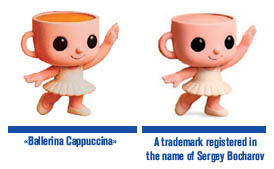 As practice shows, obtaining such additional rights is sometimes even critically necessary in order to prevent their registration in the name of competitors or “patent trolls”. Thus, the Italian company OFFICINA COMUNICAZIONE S.R.L. recently had to defend its rights in the image of an AI character called “Ballerina Cappuccina” in connection with the registration of a trademark in the name of Sergey Bocharov in respect of a broad list of Class 28 goods, including toys, and Class 35 services of the International Classification of Goods and Services.
Rospatent recognized the Italian company’s priority rights in the image of the character as a work of art and cancelled the trademark registration.
However, it is clear that the dispute could have been avoided if full protection of those rights had been secured in advance.
To access this website, we request that you read and accept the Terms of Use.